
Why You Look Bad in Photos (And How to Fix It)
The science behind why you hate photos of yourself. A photographer explains lens distortion, mirror-bias, the frozen-face effect, and the simple fixes that work.
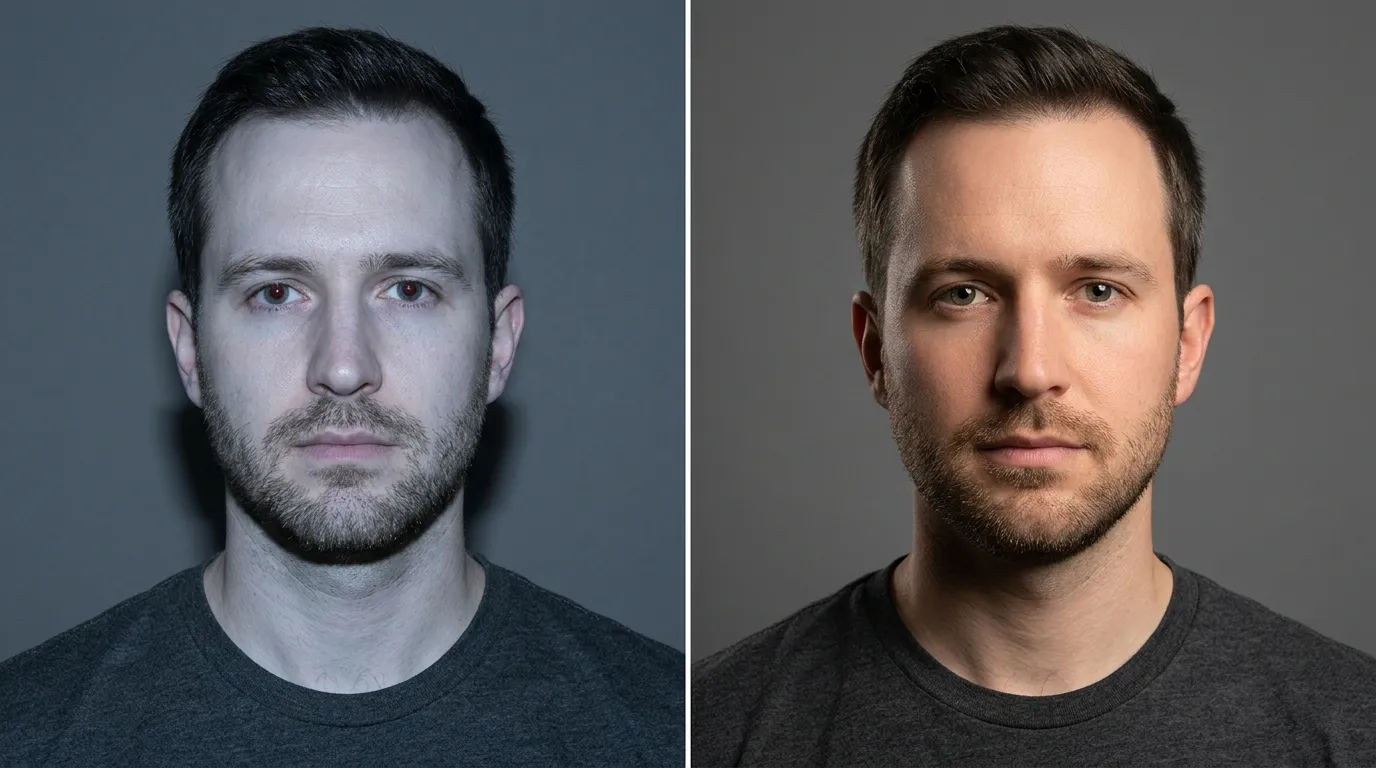
Your phone's front camera is a wide-angle lens held 12 inches from your face. That's why you don't recognize yourself in the photo. It's one of three forces working against you: lens distortion, mirror-bias (you've seen the reversed version of your face thousands of times more often), and the frozen-frame effect. All three are fixable.
The best portrait photographers know this already. And once you see the mechanics, you can't unsee them. Here's the science behind each problem, with the settings and tricks that work around it.
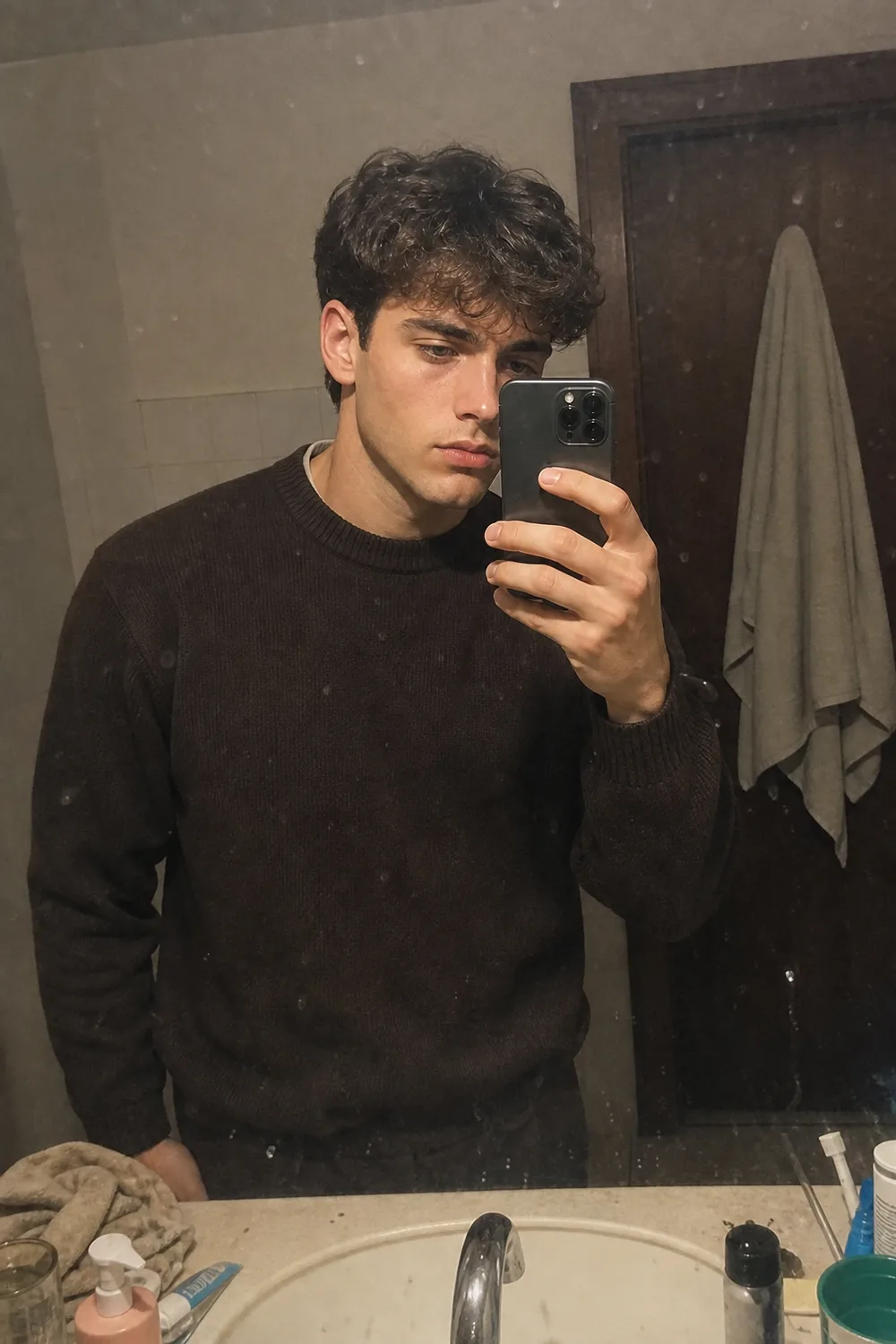 Before
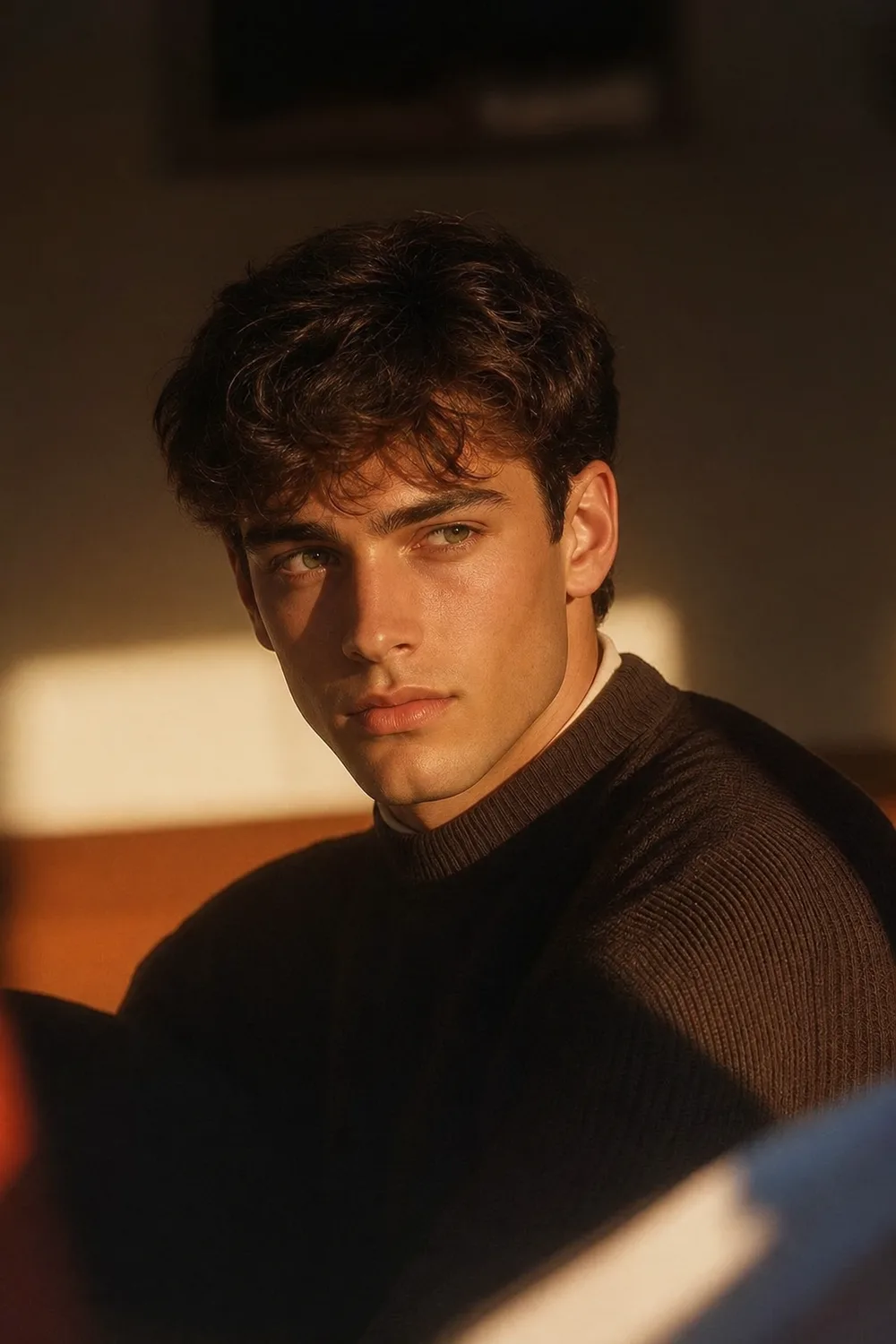 After
AfterStudio / Private by design
See yourself shot properly.
Use our AI dating photo generator to create profile pictures from four everyday selfies. Your uploads are encrypted, never used to train AI, and become inaccessible five days after upload.
Or quick sign-in from here
Your Phone Lens Is Lying About Your Face
The front camera on your phone is a wide-angle lens sitting about 12 inches from your face. That's a problem. A 2022 study by Pressler, Kislevitz, Davis, and Amirlak in Plastic and Reconstructive Surgery measured exactly how much it lies: nasal length was 6.4% longer in a 12-inch selfie than in a standard clinical portrait, and the alar base to facial width ratio dropped 10.8% (p < 0.0001, n=30 volunteers). Translation: your nose looks larger, and your face looks narrower, for purely optical reasons.
Ward et al. pushed the math further in JAMA Facial Plastic Surgery (2018). Their mathematical model showed the nose appears 30% larger in a 12-inch selfie for the average male face, and 29% larger for the average female face. "A wider field-of-view introduces a stronger perspective distortion, with faces being stretched, squished, and skewed, to look vastly different from real-life," wrote Google researcher YiChang Shih in the SIGGRAPH 2019 paper that shipped with the Pixel 3's automatic face-undistortion algorithm.
Why do portrait photographers shoot with 85mm to 135mm lenses (a focal range roughly three to five times longer than your phone's front camera)? Because at that distance, the nose and cheekbones compress into proportions that match how humans actually see each other in conversation. The trick is simple: shoot from farther away. Use your phone's rear camera at 2x zoom, prop it on a stack of books, and set the timer. The megapixel count drops a little, but the geometry is correct.
55% of patients who visit a plastic surgeon now say they partly want the procedure to improve their selfies, according to an American Academy of Facial Plastic and Reconstructive Surgery poll. That number is tragic. "If young people are using selfies as their only guide, they may be coming to plastic surgeons to fix problems that don't exist except in the world of social media," said Dr. Bardia Amirlak, lead author of the UT Southwestern study. Most of what people want to "fix" is wide-angle distortion that a tripod would solve for free.
Why You Look "Wrong" Even When the Photo Is Accurate
Sometimes the photo is fine. Your friends like it. You hate it. There's a specific reason for that.
In 1977, Mita, Dermer, and Knight ran a small study (33 female undergraduates and their close friends) that became one of the most-cited papers on self-perception. The setup: show each person two versions of their own face, the true image and the mirror-reversed image. Subjects preferred the mirror-reversed version. Their friends preferred the true version. Both groups picked the image they had seen more often in their lives. This is the mere-exposure effect, and it explains why every photo of you feels subtly off even when the image is technically correct.
Epley and Whitchurch (Personality and Social Psychology Bulletin, 2008) went further. They showed that people recognize a digitally enhanced, slightly more attractive version of their own face faster than their actual face. The effect is automatic, correlates with implicit self-worth, and applies to friends as well as the self (but not to strangers). "We have a general tendency to think of ourselves as better than we really are," Nicholas Epley told Scientific American.
Here's the part that should make you feel better. The photo is usually more accurate than the mirror, not less. Your friends, your coworkers, the person who matched with you on Hinge, all of them see the non-reversed version of your face. They like it. You're the only one carrying thousands of hours of mirror-practice expecting something different. The photo is accurate. Your brain is just loyal to the wrong reference image.
The Frozen Face Problem
Even when the lens is right and the image is accurate, there's one more issue. A still photograph captures roughly 1/60th of a second. A conversation captures continuous motion that averages out awkward micro-expressions. Post, Haberman, Iwaki, and Whitney (Frontiers in Psychology, 2012) measured this directly. Subjects rated the same face 4.6 out of 7 when shown in video, but only 3.9 out of 7 when shown as a still frame pulled from that same video (F = 11.76, p < 0.01). This is the frozen face effect.
The effect persists when images are inverted, which means motion itself drives the preference (not general configural processing, which is the usual explanation for face perception effects). People look better when they're moving. You are not an exception.
The practical fix: burst mode. Instead of tapping the shutter once and hoping, hold it down for ten frames in a row while subtly moving your head. Or shoot a short video and screen-grab the best frame. You're not vain for taking 50 photos to get one. You're stacking the odds. Most of the classic dating photo mistakes come from taking exactly one stiff shot, which is precisely the condition this study predicts will rate lowest.
Common Mistakes That Make Bad Photos Worse
Before you reach for a fix, stop doing the things that are actively compounding the three problems above. These are the patterns I see most often on dating profiles, and they're all easy to stop.
Judging your own photos by mirror feel. Your brain is biased toward your mirror reflection, so every correct photo will look slightly wrong to you. Ask a friend which shots they prefer. Or better: use a service that rates anonymously. Your own opinion is the least reliable signal in the room.
Shooting from chest height with the front camera. This combines the two worst offenders in one move. Wide-angle distortion enlarges the nose, and a low angle flattens the jaw into a double chin. If you only change one thing about your selfies, raise the phone.
Using the flash. On-camera flash sits inches from the lens and fires straight forward. That geometry creates hard shadows under the nose, erases skin texture into a waxy sheen, and produces the unmistakable "deer in headlights" look. Soft window light wins every time. Always.
Keeping only the first photo that looks "okay." The frozen-face study explains why this is a mistake. A single frame catches a random micro-expression that usually isn't your best one. Take 30 frames, delete 28. The extra 90 seconds of shooting pays back for months of profile views.
Retouching instead of rethinking. Filters and skin-smoothers layer on top of a broken image. They don't fix geometry, they don't fix mirror-bias, and they add a plastic look that people notice (and quietly hold against you). Rebuild the shot from scratch before you reach for beauty filters.
The Fix List (In Order of Impact)
Here's the ranked playbook. Do them in order. The first three solve 80% of the "I look bad in photos" problem on their own.
| # | Fix | Why it works | Effort |
|---|---|---|---|
| 1 | Back up four feet, use 2x zoom on the rear camera | Removes wide-angle distortion (Ward 2018) | Low |
| 2 | Raise the camera slightly above eye level | Defines the jaw, enlarges eyes, avoids double-chin angle | Low |
| 3 | Shoot in burst mode, then pick from 10 frames | Beats the frozen-face effect (Post 2012) | Low |
| 4 | Use soft diffused light from a window or natural overcast day | Flattens the micro-shadows that age a face | Low |
| 5 | Hand the phone to someone else entirely | Removes arm reach and mirror-bias in one move | Medium |
| 6 | Use AI generation to skip the camera | Renders the face from a trained flattering distribution | Low |
Most people skip fix #1 because it feels odd to hand the phone off. Fine. Put it on a stack of books, hit the timer, and step four feet back. That alone fixes the single biggest problem in 90% of bad dating photos. Don't shoot from below eye level either, which is the angle most selfies default to (a low angle creates a double-chin effect and flattens the jaw, per Digital Photography School's face-angle guide and Photofeeler's testing data).
If none of that works, AI is a legitimate shortcut. Dating Image Pro generates new photos from four existing selfies, aiming for portrait-style geometry instead of the wide-angle distortion baked into a phone selfie. Results arrive in minutes, web source uploads are never used for AI training, and pricing uses one-time credits with no subscription. You're using a different image-making workflow, not cheating.
And if your match rate is still low after you fix the photos, that's usually a bio or opener problem, not a face problem. Read how to get more matches on dating apps for the rest of the system.
The Takeaway
The photo is data, not judgment. Your phone lens, your mirror-trained brain, and the frozen frame are three separate forces working against you, and each one has a named study and a fixable action behind it. And you already have everything you need at home (a phone with a rear camera and a flat surface to prop it on). Good photos come down to geometry and better light, plus enough frames to pick from.
Questions, answered.
01Why do I look better in the mirror than in photos?+
Because your brain has seen your mirror-reversed face thousands of times more often than your true face. A 1977 study by Mita, Dermer, and Knight showed people prefer the version of their face they see most, which is the mirror image. Your friends prefer the photo because that's the version they see.
02Does my phone's front camera make my nose look bigger?+
Yes, measurably. A 2022 study in Plastic and Reconstructive Surgery found that nasal length appears 6.4% longer in a 12-inch selfie than in a clinical portrait. Mathematical modeling puts the perceived increase at roughly 30% compared to how people see your nose in person. Shoot from farther away with a rear camera at 2x zoom to fix it.
03What focal length is most flattering for faces?+
Portrait photographers use 85mm to 135mm on full-frame cameras. At that focal length, the face compresses into proportions that match how humans see each other in conversation. A smartphone front camera is roughly 22mm to 28mm equivalent, which is why selfies distort your features.
04Is the photo or the mirror the "real" me?+
The photo is closer to what everyone else sees. The mirror reverses your face, which hides small asymmetries your brain has grown used to. If your friends like a photo you hate, trust them, because they're seeing the non-reversed version that the rest of the world also sees.
05Why do I look fine in videos but bad in stills?+
This is the frozen face effect, documented by Post et al. in 2012. The same person rates 4.6 out of 7 in video but only 3.9 out of 7 in stills taken from that video. Motion averages out awkward micro-expressions. A still frame freezes one random 1/60th of a second, and most of those moments are unflattering.
06What camera angle is most flattering for selfies?+
Slightly above eye level, with the camera tilted down toward you. This defines the jawline, enlarges the eyes, and elongates the neck. A low angle (below eye level) creates a double-chin effect and flattens the jaw. Raise the camera an inch or two above your eyes and tilt it down roughly 10 degrees.

Author / reviewed profile
Maya Rodriguez
Maya is a professional portrait photographer with 12 years of experience. She's photographed everything from corporate headshots to dating profiles, and she knows exactly what makes a photo stand out.